Sayuri’s novice geisha status
Memoirs of a GeishaSayuri’s novice geisha status begins when a brief sake ceremony binds her to Mameha as her younger sister and replaces the name Chiyo with Sayuri. The new status is both a public transformation and a constrained apprenticeship: she has entered the profession she once wished for, but must initially learn by watching, and cannot dance or entertain alone.
Ceremony and New Identity
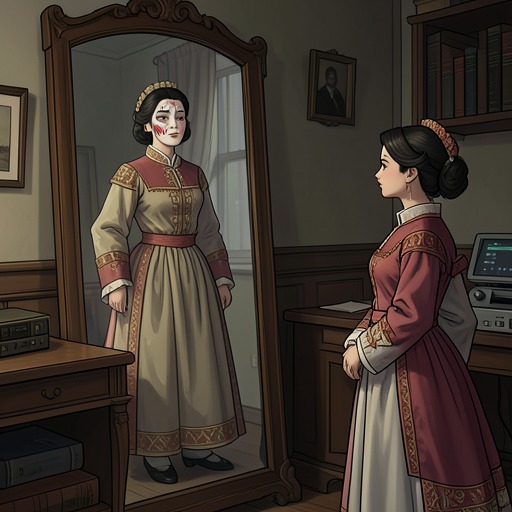
On the day of the ceremony, Sayuri bathes early and spends the morning dressing, with Auntie helping finish her makeup and hair. The white face, red lips, pink cheeks, silk flowers, and sprigs of unhusked rice make her reflection seem at once familiar and strange. Her formal black kimono bears the crest of the Nitta okiya; an embroidered dragon climbs from the hem to her thigh, its mane lacquered reddish and its claws and teeth silver. She tucks the Chairman’s handkerchief into her obi for good luck.
Auntie accompanies her to Mameha’s apartment, where Sayuri expresses gratitude and pledges to honor and respect her new older sister. They then go to the Gion Shrine, clap their hands before the gods, and pray for favor in the years ahead. Sayuri also gives thanks for the wish she made three and a half years earlier: that she might become a geisha. The steps place her professional change within a religious and social ritual, rather than presenting it as a name change alone.
The binding ceremony takes place at the Ichiriki Teahouse, attended by its mistress and lasting about ten minutes. A maid brings several sake cups; Mameha and Sayuri each take three sips from each of three cups in turn. From that moment, the former Chiyo is known as Sayuri. The name was chosen after Mameha consulted a fortune-teller: its components were selected for their meanings and astrological associations, as well as the stroke counts of their written characters. Mameha’s own name could not be incorporated because the combinations were judged inauspicious.
What Novice Status Permits
The ceremony establishes a specific, limited stage of apprenticeship. During the first month, a young geisha is called a novice and does little besides watching and learning. She cannot perform dances or entertain on her own; her older sister must accompany her. The arrangement makes Mameha not merely the sponsor of Sayuri’s new identity but also the necessary guide and professional intermediary through her first steps in the work.
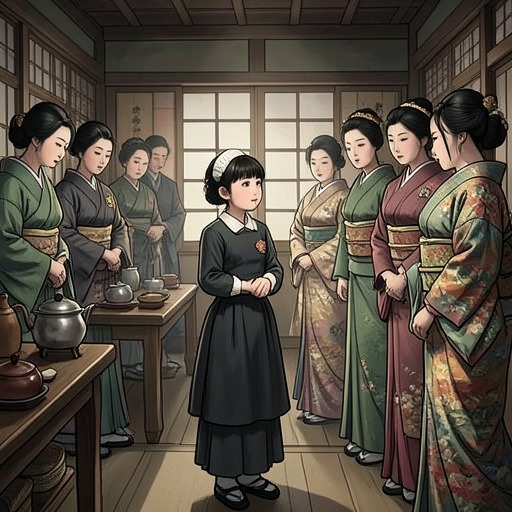
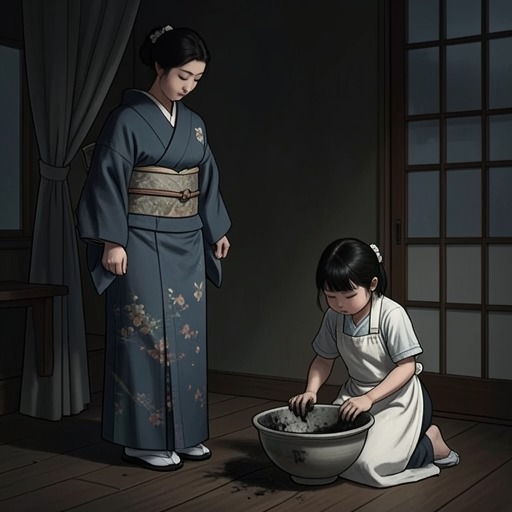
The restrictions become tangible in the lessons that follow the ceremony. Mameha takes Sayuri around Gion to introduce her to teahouse and okiya mistresses with whom she has relationships, but first corrects the way she kneels in her kimono. Sayuri must try several times before managing the posture. Mameha gives her a small gourd ornament for her obi, traditionally thought to offset the body’s heaviness and help a clumsy apprentice keep her balance. She also tests how Sayuri holds her sleeve while pretending to pour tea from an empty pot, and is dissatisfied with the attempt. The novice’s new title therefore signals entry, not readiness: even elementary movements remain subject to instruction and correction.
Clothing, Training, and Material Conditions
The professional identity Sayuri enters is made visible through clothing, but that appearance depends on skilled labor and costly materials. Dressing a geisha requires more than putting on a robe: Mr. Bekku folds excess kimono fabric at the waist, adjusts it until it lies smoothly, and ties the obi with cords, clasps, and padding to shape and secure its knot. The obi can be twice a man’s height and nearly as wide as a woman’s shoulders. Its elaborate construction shows how formal presentation is produced through technique rather than appearance alone.
The garments also belong to an expensive system of storage and reuse. The okiya’s loft holds rows of red lacquered cases, each containing several kimono wrapped in linen paper. Its collection is described as worth roughly twice as much as all the villages of Yoroido and Senzuru combined; the most expensive apprentice garments are kept separately in a rented vault. Such clothing signifies the economic infrastructure behind geisha training, not simply an individual’s taste or wealth.
That material world changes under wartime restrictions and scarcity. Later, Sayuri has accumulated only a few scrolls, inkstones, bowls, and stereoscopic photographs, including a sterling-silver viewer given to her by the Kabuki actor Onoe Yoegoro XVII. Cosmetics and permanents have been banned as luxuries, while lavish gifts have become rare. During the war, Mother grows wealthy buying and selling other people’s heirlooms, and kimono from the Arashino collection pass through her hands. These changes frame the novice’s formal clothing and professional possessions against a period in which luxury is restricted and valuable objects become commodities for survival.
The Emotional Cost of Becoming Sayuri
The change of name does not feel like an uncomplicated fulfillment. At lunch after the ceremony, Sayuri picks at the red rice and feels unsettled rather than celebratory. Hearing the teahouse mistress call her Sayuri makes the source of her unease clear: she feels that the newly made geisha has destroyed the barefoot girl Chiyo who once ran from the pond to her tipsy house. The ritual grants the wish she had prayed for, but it also gives that wish the force of a separation from her former self.
That tension is central to the meaning of her novice status. The white face, formal kimono, new name, and required deference make her transformation legible to others; the awkward kneeling, sleeve practice, and dependence on Mameha show how much remains unlearned. Sayuri has crossed into geisha life, but she does so as a beginner whose identity is at once chosen, ceremonially recognized, and shaped by the training and conventions of the profession.